Rheological and Pharmacological Evaluation of High-Strength Zingiber officinale Topical Ointments for Antinociceptive and Anti-Inflammatory Effects
##semicolon##
https://doi.org/10.4314/##semicolon##
Zingiber officinale##common.commaListSeparator## antinociceptive##common.commaListSeparator## anti-inflammatory##common.commaListSeparator## ointment##article.abstract##
Background: Zingiber officinale (ZO) is known for its pain-relieving and anti-inflammatory properties, but high-concentration topical formulations have not been well studied. This study evaluates how high extract loading affects rheological behavior and pharmacological activity.
Objectives: This study formulated ZO ointments with varying high concentrations and evaluated the impact of composition on rheological properties, antinociceptive, and anti-inflammatory efficacy in Wistar rats.
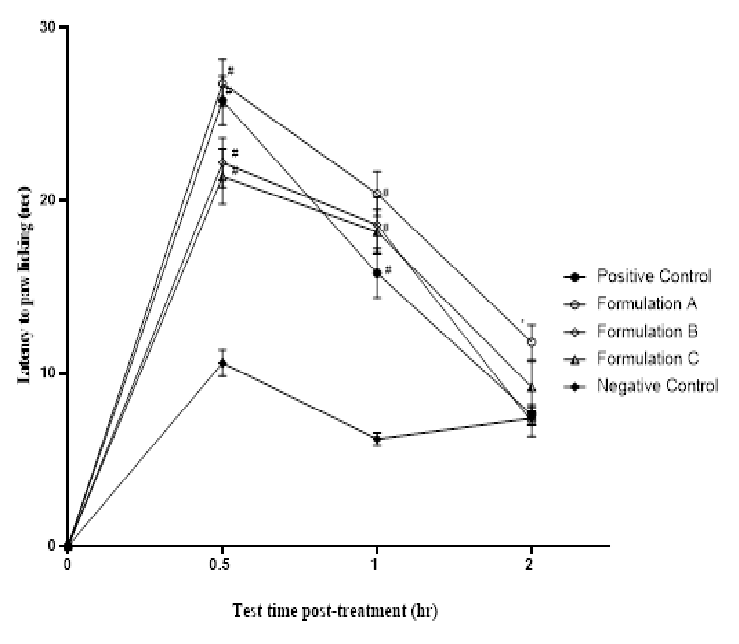
Materials and Methods: Dried ginger rhizomes were macerated in ethanol, and the extract was incorporated into ointment bases at 51.28% (formulation A), 41.03% (formulation B), and 30.77% (formulation C) w/w. Formulations were tested for physicochemical properties and efficacy using the hot-plate paw-lick and egg albumin-induced paw oedema assays. Rats received vehicle, methyl salicylate, or ZO extract (ZOE) ointments.
Results: Higher extract concentrations had better ointment spreadability and appearance. All formulations showed pseudoplastic flow, with viscosity inversely related to extract content. ZOE ointments produced dose-dependent antinociceptive and anti-inflammatory effects, with formulation A having the most significant effects.
Conclusion: Incorporating high concentrations of ZOE into topical ointments significantly enhanced both antinociceptive and anti-inflammatory efficacy. Formulation A provided the optimal balance of superior pharmacological activity and desirable physical properties. These findings indicate that ZOE ointments with higher concentrations have the potential to relieve localized pain and inflammation.
##submission.citations##
##submission.downloads##
##submissions.published##
##issue.issue##
##section.section##
##submission.license##
##submission.copyrightStatement##
##submission.license.cc.by-nc-nd4.footer##